

Car aircon not blowing cold? We fix and regas it
At Turbo & Diesel in Frankton, we fix car air conditioning by finding the leak first, repairing it, then regassing to your vehicle's exact spec on a calibrated R134a station. We are an MTA member workshop with 20+ years on Kahikatea Drive, working alongside Waikato Auto Air Conditioning, at the workshop or on-site for Waikato fleets.
4.7 from 50 Google reviews 20+ years 10,000+ vehicles serviced
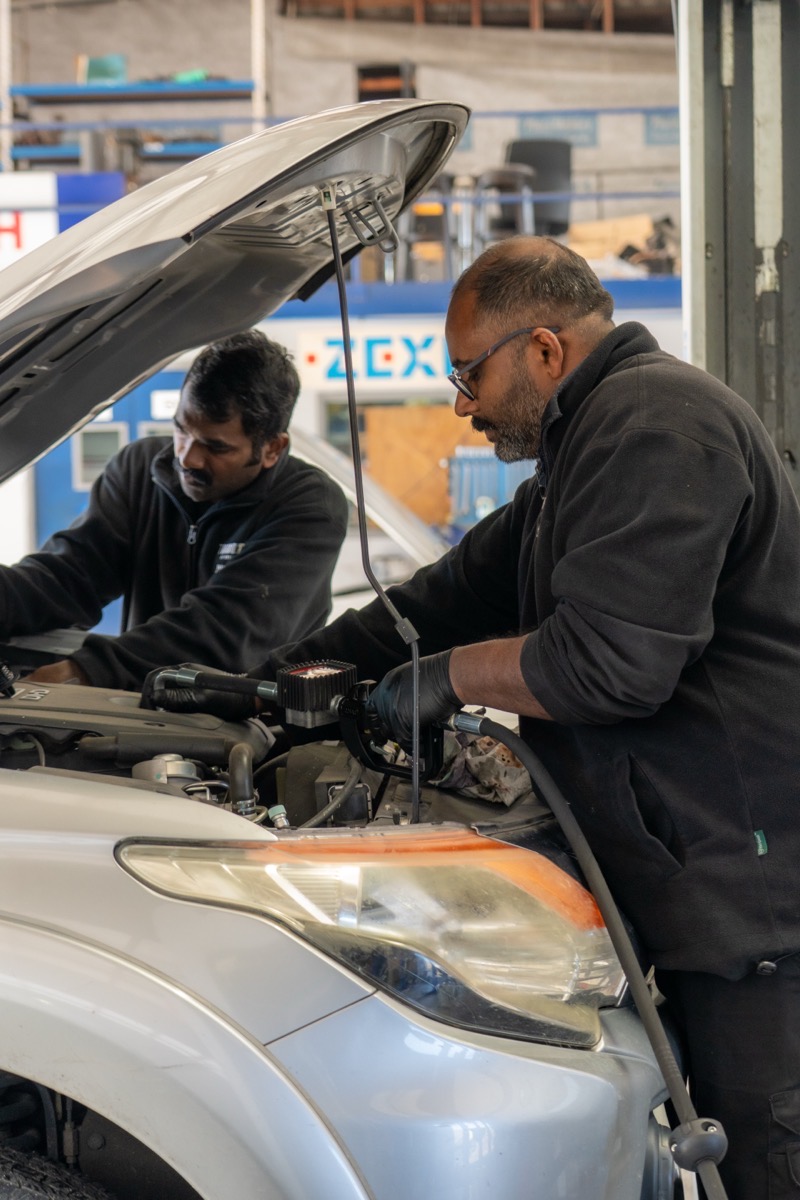
Why air conditioning service is done differently here
Real photos from the floor on Kahikatea Drive. Same team, same hoists, same standards on every job, from a quick check through to a full strip-down.







What you get when you book this service
11 checks performed on every visit
- Vent-temperature, high-side and low-side pressure measurement before any work
- Compressor drive belt, clutch and pulley bearing inspection
- Full system leak-down test using nitrogen or UV dye, then locate the leak source
- Refrigerant recovery and recycling on a calibrated R134a station
- Vacuum-pull to remove moisture and confirm the system holds vacuum
- Recharge to vehicle-specific weight of refrigerant and PAG oil
- O-ring, schrader valve, condenser, evaporator and receiver-drier replacement where needed
- Cabin (pollen) filter replacement and evaporator deodorise where odours are present
- Blower motor, blend door actuator and HVAC wiring fault diagnosis
- Heater core flow and temperature checks; heater core replacement where necessary
- Final vent-temperature verification and a written summary of work done
Want air conditioning service done right?
Phone the workshop or send a quick form, whichever suits you. We come back with a clear next step.
4.7 from 50 Google reviews 20+ years 10,000+ vehicles serviced
Why Hamilton trusts us with air conditioning service
-
Find the leak first, then regas
Topping up a leaking system wastes refrigerant and your money. We pressure-test before any gas goes in so the recharge actually lasts.
-
Calibrated R134a station
We recover, recycle and recharge R134a on a calibrated station, charging by weight to the vehicle-specific spec so the system runs as designed.
-
Workshop or mobile
Drop the vehicle at our Frankton workshop, or book us on-site for fleet vans, trucks and depot work across the Waikato.
-
Heater work in the same visit
Heater core flushes, blend door actuators and blower repairs are all done here, no second workshop for cabin-comfort jobs.
-
Twenty-plus years in Frankton
An MTA member workshop on Kahikatea Drive with 20+ years of aircon, diesel and servicing work, rated 4.7 stars across 50 Google reviews.
Simple, transparent process
- 01
Pressure and temperature check
Vent temperatures measured at all outlets. Manifold gauges connected to read high-side and low-side pressures while the compressor cycles.
- 02
Leak-down and diagnosis
Where pressures are low, nitrogen or UV-dye leak testing isolates the failure point, condenser, evaporator, O-ring, schrader valve, or compressor seal.
- 03
Repair and evacuate
Failed components replaced, then the system is vacuum-pulled for 30+ minutes to remove moisture and confirm it holds vacuum before any refrigerant goes in.
- 04
Regas and verify
Refrigerant and PAG oil charged by weight to the vehicle-specific spec. Vent temps and pressures re-verified, and a road test confirms compressor cycling.
Everything you should know about air conditioning service
A workshop perspective on what's involved, how we run the job, and what shapes the final cost.
How we fix a car AC that isn't blowing cold
If your car aircon has stopped blowing cold, the fix starts with a pressure test, not a regas. We measure both sides of the system, find where the refrigerant is leaking, repair the faulty part, then recharge to your vehicle's exact spec. Topping up the gas without fixing the leak only masks the problem for a few weeks.
Car air conditioning can almost always be fixed. The system also pulls moisture out of the cabin, which is why the windscreen demists in seconds on a cold, damp Waikato morning, so a fault costs you more than just comfort on a 30 degree day. The right starting point is always a proper diagnosis, then the repair, then the regas.
Signs your car aircon needs a regas or repair
The earlier you catch an aircon fault, the cheaper it usually is to fix. These are the signs Waikato drivers most often bring in:
- Air that is warm or only mildly cool, or takes longer than it used to before it turns cold
- Weak airflow from the vents even on the highest fan setting
- A musty or mouldy smell when you first switch the AC on
- Whirring, clicking or rattling from the compressor when the system engages
- The windscreen taking longer than usual to demist on cold mornings
- Visible oily residue around AC pipes and fittings under the bonnet, a classic sign of a refrigerant leak
A slow refrigerant leak is the most common problem in a car AC system, and it rarely fixes itself. A 20 to 30 minute pressure test tells us whether you need a straightforward regas or a repair before any gas goes near the system.
What our car air conditioning repair work covers
Every job starts with measurement. Manifold gauges go on to read both sides of the system, vent temperatures are recorded at all outlets, and the compressor is watched through several engagement cycles. If pressures are wrong, the next step is a leak-down test using nitrogen or UV dye. We find the leak before any new refrigerant goes near the system, because pumping gas into a leaky line is throwing money away.
The repair side covers what actually fails on NZ vehicles:
- Condenser stone damage from gravel roads
- Evaporator pin-holes from age
- Perished O-rings at fitting joints and schrader valve seals
- Tired receiver-driers and compressor shaft seals
When components need to come out, we do it once, properly. Refrigerant is recovered into a sealed recycling cylinder on a calibrated station, never vented. The system is then vacuum-pulled to remove every trace of moisture, held under vacuum to confirm it is sealed, and recharged by weight to the vehicle-specific specification with the correct grade of PAG oil.
We service R134a air conditioning systems, which covers the large majority of vehicles built up to around 2016 and many since, from Corollas and Swifts to Hilux, Ranger and Triton utes and the vans and light trucks Waikato businesses run every day. If you are not sure what your vehicle uses, call us with the make, model and year and we will confirm we can service it before you book in.
Heater-side work is done in the same visit: heater core flushes, blend-door actuator faults, blower motor replacements, HVAC controller diagnostics. Whatever is wrong with the cabin climate, we sort it under one roof.
How an AC job runs at our Frankton workshop
You drop the vehicle in the morning. A technician connects manifold gauges, reads pressures and vent temperatures, and listens to the compressor. If the system holds gas correctly, we do a maintenance regas and a cabin-filter check. If pressures are low, we move to a nitrogen leak-down or UV dye trace, usually one to two hours.
Once the failure point is confirmed, we call you with the actual job before any parts go on order. Repairs are typically same-visit for O-rings, schrader valves, receiver-driers and common compressors. Condenser and evaporator work usually takes a working day plus parts lead time.
Before you collect, the system is pulled to a deep vacuum, charged by weight, and re-verified for vent temperature and compressor cycling on a short road test.
What a car aircon regas and repair costs in New Zealand
We quote every aircon job upfront once we know what your vehicle needs, and we confirm any repair cost with you before work starts. We do not publish our own rates, because the right number depends entirely on what the pressure test finds.
Across New Zealand, a straightforward car aircon regas typically costs between $150 and $300, though the exact price depends on your vehicle and the extent of the work. Where there is a leak to trace and repair, or a component like a condenser or compressor to replace, the total climbs from there, and the compressor is usually the most expensive single part in a car AC system. For an accurate quote for your vehicle, get in touch with our team on (07) 847 3339 or use the contact form.
Three things move the number:
- Failed component - a perished O-ring is a quick fix; a seized compressor that contaminates the lines means flushing the whole circuit
- Parts availability - some condensers and compressors are model-specific with longer lead times
- Diagnostic time - a clean leak-down is fast; an intermittent leak in a hidden evaporator takes longer to isolate
Why Hamilton drivers choose Turbo & Diesel for aircon work
Turbo & Diesel has been the Hamilton workshop for aircon, servicing and diesel work for over twenty years, from our base on Kahikatea Drive in Frankton. We are an MTA member workshop with a team of more than ten technicians, and we hold a 4.7 star rating across 50 Google reviews.
Air conditioning is a genuine specialty here, not a sideline. We work alongside Waikato Auto Air Conditioning, and every job runs through a calibrated R134a recovery and recharge station so the system is charged by weight to your vehicle's exact spec. You can drop your vehicle at the workshop, or for fleet vans, trucks and pool cars at a single site, we bring the recovery gear to your depot to cut downtime.
Hamilton and Waikato coverage
Our workshop is at 281 Kahikatea Drive, Frankton, three minutes from the Hamilton ring road with off-street parking. Most AC customers come from Hamilton suburbs including Hillcrest, Rototuna, Te Rapa and Chartwell, with plenty driving in from Cambridge, Te Awamutu, Morrinsville, Huntly, Ngaruawahia and Raglan.
For fleet operators with vans, light trucks or pool vehicles at a single depot, we bring the recovery station and tooling on-site to reduce downtime. The workshop is open Monday to Friday, 7:30 AM to 4:30 PM, closed weekends, and we can arrange an overnight drop-off for fleets that cannot spare a vehicle during the day.
Last reviewed and updated
Common Questions
Everything you might want to know before booking.
How do I fix my car AC not blowing cold air?
Start with a pressure test, not a regas. When an aircon stops blowing cold, the cause is almost always a slow refrigerant leak, so we measure both sides of the system, trace where the gas is escaping, repair the faulty part, then recharge to your vehicle's exact spec. Simply adding gas only masks the fault for a few weeks.
How much does it cost to regas a car aircon in NZ?
Across New Zealand, a straightforward car aircon regas typically costs between $150 and $300, though the exact price depends on your vehicle and the extent of the work. If the system has lost gas there is almost always a leak worth finding first, so we pressure-test before recharging. For an accurate quote for your vehicle, call us on (07) 847 3339.
How much does it cost to fix an air conditioner in a car?
It depends on what has failed. Across New Zealand, car AC repairs commonly range from around $200 for a small leak or perished O-ring up to $1,500 or more when a compressor or condenser needs replacing. For an accurate quote for your vehicle, get in touch with our team on (07) 847 3339 or use the contact form.
How can I tell if my car aircon needs regassing?
The clearest signs are air that is warm or only mildly cool, air that takes longer than it used to before turning cold, and weak airflow from the vents. A healthy system should not lose refrigerant, so if yours is down on gas there is usually a leak behind it. A 20 to 30 minute pressure test confirms it.
What is the most expensive part of a car AC?
The compressor is usually the priciest single component, since it is the pump that drives the whole system and often takes refrigerant, oil and a receiver-drier with it when it fails. Condensers and evaporators can also run high on some models. Catching a leak early is the best way to avoid a compressor bill later.
How often should you regas the AC in a car?
A healthy system should not need regassing on a schedule, because it does not consume refrigerant. If yours needs gas every year or two, there is a leak that should be found and fixed. As general maintenance, having the system pressure-checked every couple of years catches small leaks before they damage the compressor.
Can you come to my workplace to service fleet vehicles?
For fleet jobs with several vehicles at one site, yes. We bring the recovery station and tooling to your depot to keep vans, utes and pool cars on the road. For a single vehicle the workshop is faster and lets us properly diagnose anything we find, so give us a call and we will advise the best option.
Do you offer WINZ-approved quotes for aircon repairs?
Yes. We are a WINZ-approved workshop and can provide formal written quotes you can submit to Work and Income when air conditioning work forms part of a vehicle-repair grant. Call (07) 847 3339 or use the contact form and we will prepare the paperwork you need.
Related services
Need air conditioning service?
Get a free quote, phone or form, whichever's easier.
4.7 from 50 Google reviews 20+ years 10,000+ vehicles serviced